Women's Health: What Your Monthly Cycle Reveal About Your Health & Hormones?


What Your Hormones (and Your Body) Are Trying to Tell You?
Most women are told that a “normal” menstrual cycle is 28 days. In reality, healthy cycles can range from about 24 to 35 days. What matters more than the number itself is why a cycle is shorter or longer—and what symptoms come with it.
A short (~24-day) or long (~35-day) menstrual cycle reflects different hormone timing and balance, not simply “too much” or “too little” estrogen. In both Western medicine and Traditional Chinese Medicine (TCM), cycle length offers valuable clues about ovulation timing, metabolic rhythm, stress physiology, and overall system balance.
Understanding why a cycle is short or long allows treatment to be precise and personalized rather than generic.
The Key Concept (Western + TCM Agree)
The luteal phase (after ovulation) is usually stable at 12–14 days.
➡️ Most differences in cycle length come from the follicular phase (before ovulation).
In plain terms:
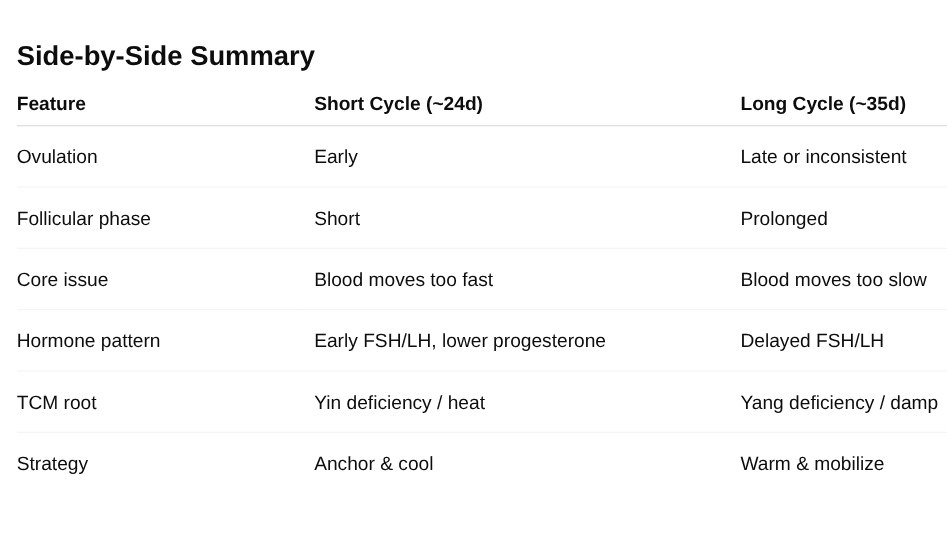
Short cycles = ovulation happens too early
Long cycles = ovulation happens too late or inconsistently
Short Cycles (~24 Days): Early Ovulation
Western Hormone Interpretation
In short cycles, the follicular phase is shortened, and ovulation occurs earlier than expected.
Typical hormone patterns include: FSH rises earlier andis often higher, recruiting follicles quickly. Estrogen (E2) rises rapidly and peaks sooner. LH surge occurs earlier. Progesterone may be normal in length, but often lower overall if ovulation quality is suboptimal.
This pattern is commonly seen with chronic stress, high baseline FSH, perimenopause (early or transitional), and low ovarian reserve in some cases.
Clinical clues include ovulation around cycle day 9–11, cycles that gradually shorten over time, and symptoms such as PMS, spotting, or lighter bleeding.
TCM Interpretation: “Early Period” (经早)
In TCM, short cycles mean Blood is moving too fast, usually because Yin cannot anchor Yang, or heat accelerates circulation.
The most common patterns include:
Kidney Yin deficiency with empty heat: Yin is insufficient to hold the cycle, so menstruation comes early. This often presents with night warmth, sweating (including during meals), anxiety, poor sleep, and fatigue despite normal labs.
Liver Qi constraint transforming into heat: Stress causes Qi stagnation, which generates heat and speeds up Blood movement. PMS, irritability, breast distension, and headaches are common.
TCM Treatment Strategy for Short Cycles
The goal is not stimulation, but anchoring and cooling.
Treatment principles:
Nourish Kidney Yin
Clear deficiency heat
Stabilize Chong and Ren vessels
Common formulas:
Dang Gui Liu Huang Tang (当归六黄汤) – especially when sweating and sleep disturbance are prominent
Liu Wei Di Huang Wan (六味地黄丸) or Zhi Bai Di Huang Wan (知柏地黄丸) depending on heat signs
Jia Wei Xiao Yao San (加味逍遥散) if Liver heat is significant
Acupuncture often focuses on KI 3 (太溪), KI 6 (照海), SP 6 (三阴交), REN 4 (关元), LIV 8 (曲泉).
Long Cycles (~35 Days): Delayed Ovulation
Western Hormone Interpretation
Long cycles reflect a prolonged follicular phase, meaning ovulation is delayed or inconsistent.
Typical hormone patterns include: FSH rises slowly or inadequately early in the cycle. Estrogen rises gradually and may remain moderately elevated for longer. LH surge is delayed or irregular. Progesterone is usually normal if ovulation occurs, but ovulatory cycles may be fewer
This pattern is commonly associated with:
Insulin resistance (even with normal A1C)
PCOS-spectrum physiology
Hypothalamic suppression from stress, under-fueling, or over-exercise
Clinical clues include ovulation after day 20–25, bloating, water retention, weight-sensitive cycles, acne, or skipped periods.
TCM Interpretation: “Late Period” (经迟)
In TCM, long cycles indicate Blood is not generated or moved efficiently. Common patterns include:
Kidney Yang deficiency: The warming, activating force of the body is insufficient, so follicle development is slow. This often presents with cold sensitivity, bloating, water retention, low energy, and long cycles with scanty flow.
Spleen Qi deficiency with damp / phlegm obstruction: Weak digestion leads to damp accumulation, which obstructs normal ovarian and cycle function. This mirrors the metabolic patterns seen in PCOS.
Blood deficiency: When Blood is insufficient, the body delays menstruation until enough is available.
TCM Treatment Strategy for Long Cycles
The goal is movement and transformation, not cooling. Treatment principles:
Strengthen digestion
Move Liver Qi
Warm and mobilize where appropriate
Common formulas:
Chai Hu Gui Zhi Tang (柴胡桂枝汤) – to regulate Liver Qi and cycle timing
Jian Pi Tang (健脾汤) – to strengthen digestion and reduce damp
You Gui Wan (右归丸) or Jin Gui Shen Qi Wan (金匮肾气丸) when Yang deficiency is clear
Cang Fu Dao Tan Tang (苍附导痰汤) in phlegm-damp / PCOS-type patterns
Acupuncture commonly includes LV 3 (太冲), ST 36 (足三里), SP 6 (三阴交), REN 12 (中脘), ST 29 (归来).
Important Clinical Nuance
Cycle length alone is not a diagnosis. What matters more is:
Ovulation timing
Luteal phase length
Mid-luteal progesterone
Symptom pattern matched with Traditional Chinese Medicine diagnosis techniques, e.g., tongue and pulse.
From a TCM standpoint, mistreating the pattern worsens the cycle:
Tonifying Yang in short cycles accelerates bleeding
Heavily nourishing Yin in long cycles with damp worsens stagnation

Conclusion: Embracing a Balanced Approach
Short and long cycles are not “good” or “bad.” They are signals.
When interpreted correctly—through both hormone physiology and TCM pattern logic—they provide a precise roadmap for treatment that supports the whole system, not just the calendar.
Understanding women's health requires a multifaceted approach that considers both hormonal insights and traditional practices. By integrating Traditional Chinese Medicine with modern healthcare, women can achieve better health outcomes and improve their quality of life. Embracing this balanced approach empowers women to take control of their health and well-being.