Women's Health: Decoding Hormone Lab Results through TCM Patterns


Understanding Hormonal Health in Women
Women's health is intricately connected to hormonal balance. Hormones like estrogen, progesterone, and testosterone play crucial roles in regulating various bodily functions. When these hormones are out of balance, they can lead to a variety of health issues. Traditional Chinese Medicine (TCM) offers a unique perspective on understanding and addressing these imbalances.
Many patients are told their labs are “normal” — yet they still feel exhausted, bloated, gain weight easily, or have irregular cycles. Lab results don’t stand alone. In real practice, they make the most sense when matched to symptoms, cycle timing, and TCM patterns. Below is how I translate common hormone and metabolic labs into actionable treatment logic.

Hormone Levels in a Normal Cycle
Starting w the 1st day of your period (Day 1), your monthly cycle can be split into the Follicular Phase and the Luteal Phase.
The Follicular Phase is characterized by rising estrogen and FSH (follicle-stimulating hormone) to develop eggs, peaking with a LH surge for ovulation, while the Luteal Phase is dominated by high progesterone to prepare for pregnancy, falling if fertilization does not occur. The follicular phase starts with menstruation, while the luteal phase is consistently about 14 days.
See the Hormone Level Graph from UCSF
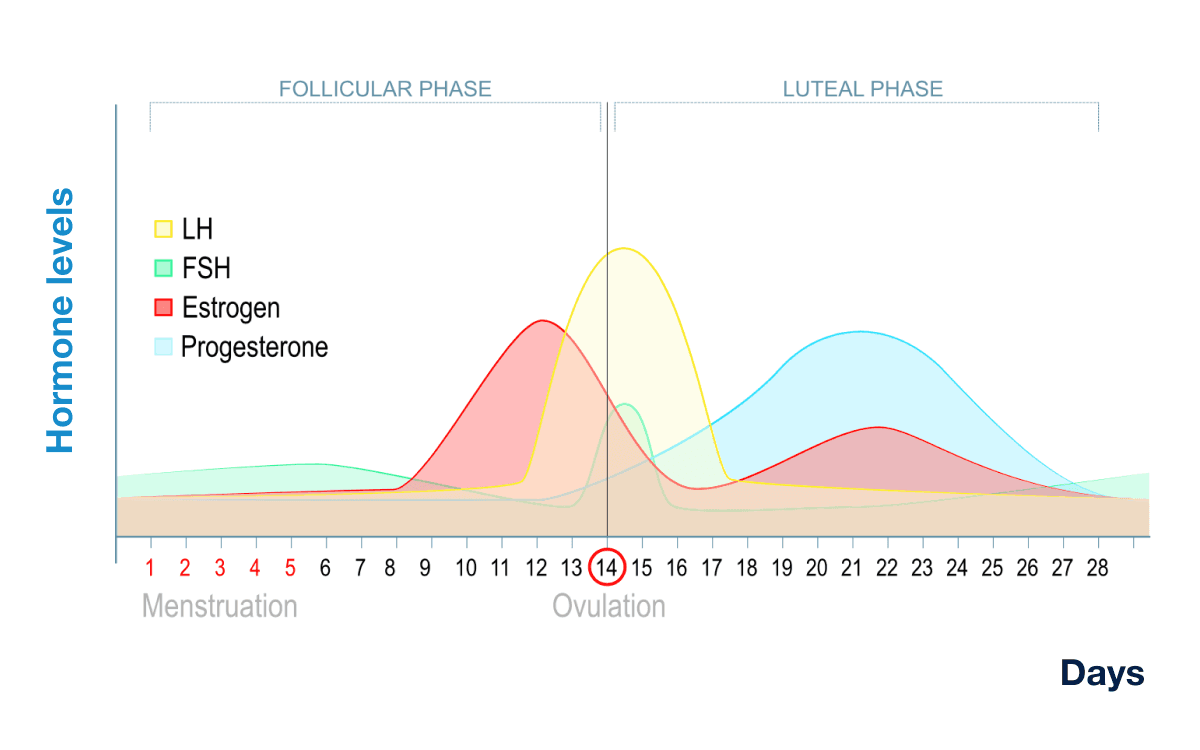
Source: https://crh.ucsf.edu/about-fertility/normal-menstrual-cycle
Follicular Phase (Day 1 to ~14)
Estrogen: Low at the beginning (menstruation) and rises steadily as the follicle matures, peaking just before ovulation.
FSH (Follicle-Stimulating Hormone): Rises early in the phase to stimulate follicles.
LH (Luteinizing Hormone): Low, but experiences a sharp, dramatic "surge" at the end of this phase, triggering ovulation.
Progesterone: Remains low.
Physiological Effect: Rising estrogen brings higher energy, improved mood, and increased motivation.
==> Ovulation typically occurs on Day 10-18
Luteal Phase (Day 15 to ~28)
Progesterone: Dominates this phase, produced by the corpus luteum (empty follicle) to thicken the uterine lining.
Estrogen: Rises again, along with progesterone, to support the uterine lining.
FSH & LH: Suppressed to low levels to prevent new follicle development.
If no pregnancy: Progesterone and estrogen crash at the end, leading to menstruation.
Physiological Effect: Higher progesterone often brings lower energy, calmness or moodiness, and potential PMS symptoms (bloating, irritability).
Cycle Day 2–4 Labs (Baseline Hormone Signal)
These labs reflect the body’s starting point at the beginning of each cycle.
FSH (Follicle-Stimulating Hormone)
Western view — “The Wake-Up Signal”: FSH is the hormone your brain uses to tell your ovaries to start the cycle. Higher FSH means the brain is working harder to stimulate the ovaries.
TCM translation:
• Elevated or early-rising FSH → Kidney Yin deficiency (the system lacks reserves, so it “pushes harder”)
• Low or sluggish FSH → Kidney Yang deficiency or Phlegm–Damp obstruction (not enough warming or movement)
In TCM terms, this reflects the well-being of your Kidney/reproductive system.
Estradiol (E2)
Western view — “The Growth Hormone": Estrogen helps follicles mature and builds the uterine lining. It should be low-moderate early, then rise steadily toward ovulation.
TCM translation:
• Early or fast-rising E2 → Empty heat from Yin deficiency (blood moves too quickly)
• Low or delayed E2 rise → Blood deficiency or Spleen Qi deficiency (not enough raw material)
In TCM, this relates to Blood and Yin nourishment — the body’s ability to build and sustain.
LH (Luteinizing Hormone)
Western view — “The Ovulation Trigger”: LH surges to release the egg.: Triggers ovulation when it surges.
TCM translation:
- • High LH or high LH:FSH ratio → Liver constraint + phlegm (often PCOS-type patterns)
- Flat or delayed LH → Kidney Yang deficiency or Qi stagnation
This reflects how smoothly Liver Qi is flowing — stress and tension matter here.
Mid-Luteal Labs (7 Days Post-Ovulation)
This phase tells us whether ovulation was strong and well-supported.
Progesterone
Western view — “The Stabilizer”: Progesterone supports implantation, sleep, and calm after ovulation.: Reflects ovulation quality and luteal support.
TCM translation:
• Low progesterone → Kidney Yang deficiency or Spleen Qi deficiency
• Normal progesterone with PMS symptoms → Often Qi stagnation rather than hormone failure
In TCM, this often ties to Kidney Yang and Spleen Qi.
Clinical Recap: This is why “normal labs” don’t always mean a normal cycle.

Metabolic & Thyroid Labs (Often Overlooked)
These labs quietly drive cycle length, weight gain, and fatigue.
TSH / Free T4
• Borderline high TSH → Kidney Yang deficiency
• Low-normal thyroid with fatigue → Spleen Qi deficiency
In TCM, this is Yang and/or Qi deficiency.
Fasting Insulin / A1C
• Insulin resistance → Phlegm–Damp accumulation
• Weight gain with normal glucose → Qi deficiency with damp retention
In TCM, this often shows up as Damp accumulation.
Ferritin / Iron Panel
• Low ferritin (even without anemia) → Blood deficiency
• Fluctuating iron with fatigue → Spleen not holding blood
This reflects Blood deficiency and Spleen strength.
By interpreting hormone lab results using the TCM patterns, practitioners can identify underlying disharmonies in the body and provide targeted treatments. This approach provides valuable insights into effectively decoding hormone lab results and using herbal formulas and acupuncture to regulate and restore our bodies.
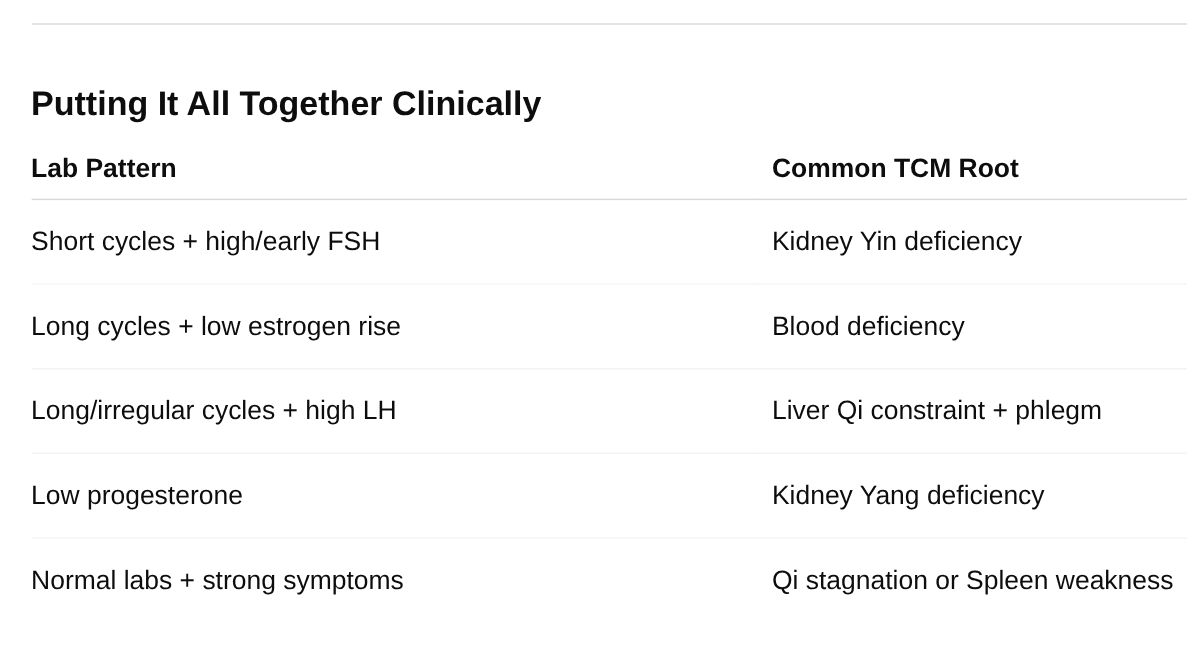
Decoding Hormone Labs with TCM
In Western medicine, hormone labs typically measure levels of specific hormones in the blood. TCM, however, looks beyond these numbers.
Two patients can have identical lab values and need completely different treatments. TCM doesn’t treat numbers — it treats how the body is adapting to those numbers.
Practitioners interpret lab results alongside w TCM diagnosis techniques (tongue and pulse) with cycle length, ovulation timing, sleep, digestion, weight, and stress.
We can choose formulas, acupuncture points, and lifestyle strategies that actually correct the root pattern, not just chase hormones. We assess the body's overall energy flow and how well organs function in harmony. By integrating these approaches, a more comprehensive understanding of hormonal health can be achieved.
Using TCM patterns, practitioners can identify imbalances related to stress, diet, lifestyle, and emotional health. This holistic view considers not just the symptoms but also the root causes of hormonal disturbances.
Key TCM Patterns Contributing to Hormonal Imbalance
Several common TCM patterns are associated with hormonal imbalances in women. Understanding these can be pivotal in addressing health concerns:
- Liver Qi Stagnation: Often related to stress and emotional disturbances. It can affect menstrual cycles and cause mood swings.
- Spleen Qi Deficiency: Linked to fatigue, digestive issues, and irregular menstruation.
- Blood deficiency: Not enough nourishing blood to fully fuel energy, hormones, and tissues, leading to fatigue and light periods.
- Kidney Yin Deficiency: May lead to symptoms like hot flashes, night sweats, and insomnia.
- Kidney Yang Deficiency: Not enough internal warmth and drive, so metabolism, ovulation, and circulation all run slowly.
- Phlegm / Damp accumulation: Not processing fluids and food efficiently, showing up as bloating, weight gain, cysts, or foggy energy.
By recognizing these patterns, practitioners can offer personalized treatments, including dietary changes, acupuncture, and herbal remedies.
Integrating TCM with Modern Medicine
Combining TCM with modern hormone labs provides a powerful tool for women's health. While lab tests offer precise measurements, TCM adds context and depth to these numbers. This integrative approach ensures a more personalized and effective treatment plan.
Practitioners can monitor hormone levels while addressing underlying patterns, providing a balanced approach to treatment. This can lead to improved outcomes for conditions like PCOS, menopause, and menstrual irregularities.
The Role of Lifestyle in Hormonal Balance
TCM emphasizes the importance of lifestyle in maintaining hormonal health. Stress management, proper nutrition, and regular exercise are vital components of this approach. Mindfulness practices like meditation and tai chi can also support overall well-being.
By adopting a lifestyle that harmonizes with TCM principles, women can enhance their hormonal balance and overall health. This proactive approach empowers individuals to take control of their well-being.
The Big Takeaway
Women's hormonal health is a complex and multifaceted issue. By integrating Traditional Chinese Medicine with modern hormone labs, a more holistic understanding and treatment of hormonal imbalances can be achieved. This approach not only targets symptoms but also addresses the root causes, offering a comprehensive path to wellness. We don’t treat numbers alone. We treat patterns, timing, and work with your body to restore naturally.
Understanding and applying these principles can lead to improved health outcomes and a more balanced life. As more women explore this integrative path, they find themselves empowered to make informed decisions about their health and well-being.
---------------
Additional Sources:
[1] https://roshmfm.com/follicular-vs-luteal-phase-whats-the-difference/
[2] https://www.samphireneuro.com/en-us/blog/luteal-vs-follicular-phase-whats-the-difference
[3] https://www.youtube.com/watch?v=faT0IIWDr3Y
[4] https://www.ncbi.nlm.nih.gov/books/NBK500020/
[5] https://healthy.kaiserpermanente.org/washington/health-wellness/healtharticle.phases-of-the-menstrual-cycle
[6] https://www.naturalcycles.com/cyclematters/what-is-the-menstrual-cycle
[7] https://www.ncbi.nlm.nih.gov/books/NBK279054/
[8] https://my.clevelandclinic.org/health/body/23953-follicular-phase
[9] https://www.trinityhealthmichigan.org/blog-articles/cycle-syncing-through-your-menstrual-phases
[10] https://www.youtube.com/watch?v=h36poEtEbi4